Hail Damage Roof STL · Correcting the record
Matching and partial roofs: what Missouri actually says
Hail took one slope, the insurer scoped one slope, the shingle is discontinued, and the house is about to be two colours. Whether you are owed a matching roof is decided by your policy's wording, not by a Missouri statute. Here is what to read tonight, and what a tie-in physically looks like.
Somebody has probably already told you that Missouri law requires the insurer to replace the whole roof so that it matches. It does not. There is no such law, and repeating that claim to an adjuster is the fastest way to lose credibility in a conversation you needed to be taken seriously in.
What follows is what is actually true, the four clauses to find in your own policy tonight, and what a tie-in between new work and fifteen year old shingles physically looks like on the roof.
What is actually true
Missouri has no matching statute and no matching regulation governing roof surfaces. Nothing in the Missouri Revised Statutes and nothing in the Code of State Regulations requires an insurer to replace undamaged roof slopes so that a repaired roof presents a uniform appearance.
The regulation people quote at adjusters is not a roofing rule at all. It sits in the motor vehicle claims part of the Missouri Code of State Regulations and it governs automobile body repair practices. It has nothing to do with residential roofing, and citing it is a fast way to lose credibility in a conversation you needed to be taken seriously in. The uniform appearance language people attach to it comes from another state's rule, not from Missouri's.
Missouri has also never enacted a state roofing licence. Bills were filed in 2016, 2019 and 2021 and all of them failed. Any page citing one of those bill numbers as though it were law is citing something that never became law.
What Missouri does have
Case law, which is a different and weaker thing than a statute, and which turns on the wording of the policy in front of the court. The Missouri authority people point to is Alessi v. Mid-Century Insurance Company, 464 S.W.3d 529 (Mo. App. E.D. 2015). Read it, or have somebody read it for you, before treating it as a rule that automatically applies to your situation, because appellate decisions about insurance contracts are about the specific contract language at issue.
The short version
Whether an insurer owes you a matching roof in Missouri is a question about your policy's wording, not a question about state law. Two neighbours with identical damage and different carriers can get different answers, and both answers can be correct.
Alessi v. Mid-Century Ins. Co., 464 S.W.3d 529 (Mo. App. E.D. 2015)
So what should you actually read
Your own policy, and specifically these:
- Any matching or uniform appearance provision. Some policies address it directly, some add it by endorsement, some are silent. Silence is where the arguments happen.
- The roof surfacing settlement basis. Replacement cost or actual cash value, and whether there is a payment schedule that reduces the roof payout with age.
- Any cosmetic damage exclusion. Usually aimed at metal, and relevant to accessories and trim as well as panels.
- The wind and hail deductible. Frequently a percentage of the dwelling limit rather than a flat figure.
The physical side, which is separate from the coverage side
Even where partial replacement is covered and paid, it has real constraints that a contractor should tell you about in advance.
- Discontinued product. Shingle lines change constantly. A fifteen year old profile may simply not be manufactured, and the nearest current equivalent may differ in thickness as well as colour.
- Weathering. Even an identical product installed today will not match a slope that has been in the Missouri sun for fifteen years. Colour drift is unavoidable.
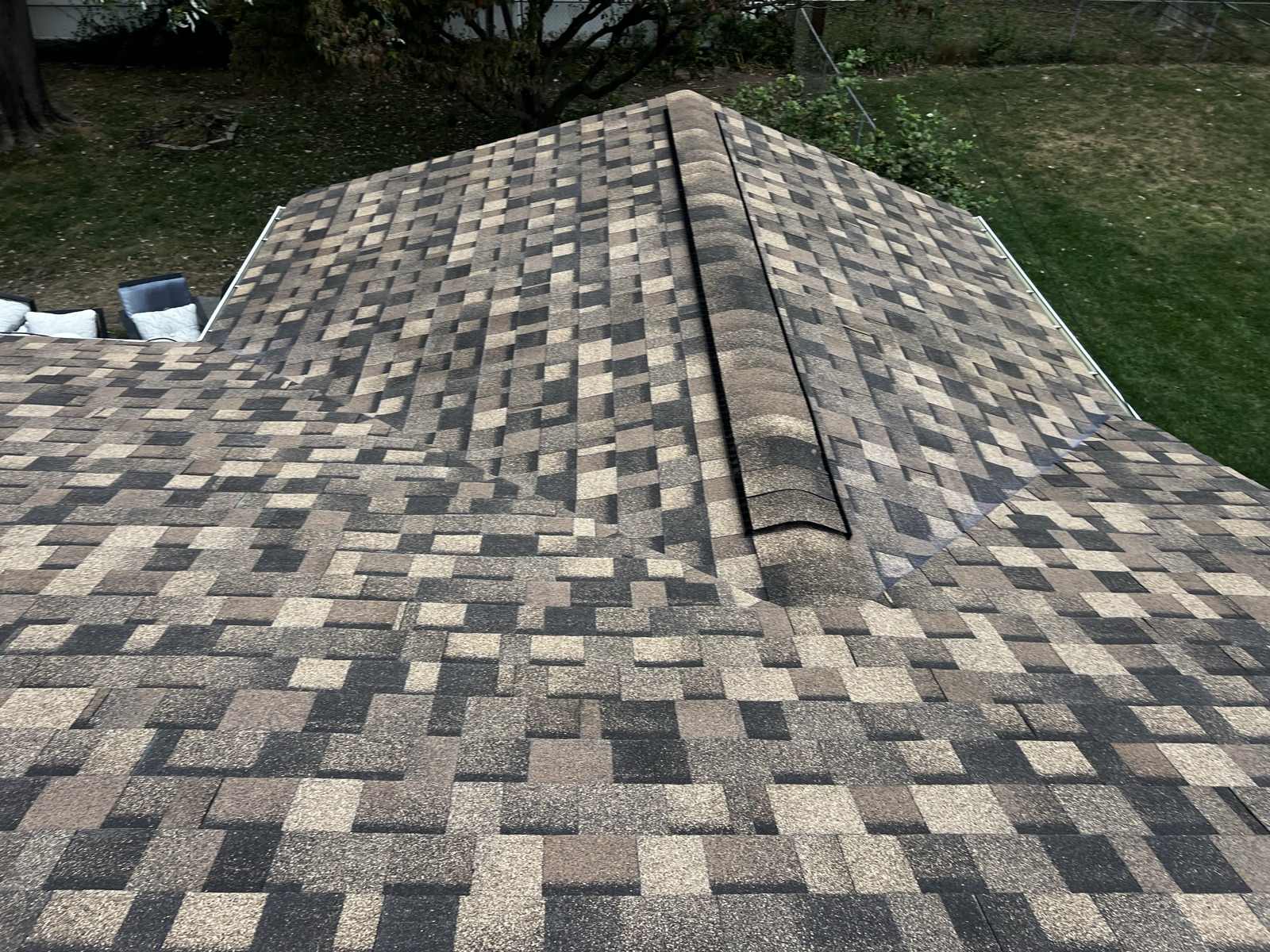
- The tie-in. Where new work meets old at a ridge, a hip or a valley, existing shingles have to be lifted and re-laid, and aged shingles are brittle. Some of them break in the process.
- Course alignment. Exposure dimensions vary between product lines. A modern shingle laid against an old one can leave courses that do not line up across the tie-in.
None of that means a partial repair is wrong. Plenty of them are correct, sensible and last for years. It means that if a slope repair is what is covered, you should know what it will look like and how it will be built before it happens, and a contractor who documents that honestly is doing you a service that a contractor who quietly proceeds is not.
What to get in writing before anything comes off
Photographs of the existing product. The line identified where it can be identified, and a note where it is discontinued. The tie-in condition at every ridge, hip and valley described. And a plain statement of what a partial replacement will and will not achieve, in writing, before the decision rather than after it, which is the only point at which any of it is useful to you. If the coverage question becomes a genuine dispute, the people who can argue it for you are a licensed public adjuster or a lawyer, because RSMo 407.725 bars a contractor from that role.
Before anything comes off
Photograph the existing product while it is still up there
The product line, the tie-in at the ridge and the hip, the aged caps that may not survive being lifted, and what the two slopes will actually look like beside each other. Documented and in writing before the decision, which is the only point at which it is any use.
Keys Roofing
Have every slope measured, not just the scoped one
This desk is published by Keys Roofing, the roofing, gutter and downspout contractor for greater St. Louis. When you are ready for someone on the roof with a camera, this is the crew that climbs it.
- Licensed and insured, greater St. Louis
- Atlas and Malarkey shingles, installed by the company you call
- Roofing, gutters and downspouts. Nothing else.
- Every photograph on this desk is a real Keys jobsite
Quicker by phone(314) 220-2333
Partial or whole
Send it, get a callback
Send it and say which slope was scoped. The office rings back to set a time.