Hail Damage Roof STL · The mechanics
What hail does to a shingle, and why your roof looks fine
Three separate things happen to a shingle when hail hits it. Only one of them is visible from the ground, and the two you cannot see are the ones that end the roof, quietly, several years later. That is the whole reason a storm roof gets looked at now rather than when it starts leaking.
Your roof looks exactly as it did the day before the storm. That is the normal outcome and it is not reassuring, and the reason is in how a shingle is built. An architectural asphalt shingle is a sandwich. In the middle is a fibreglass mat, which is the structure and the thing that holds a nail. Over it is asphalt, which is the waterproofing. Over that is a layer of ceramic-coated mineral granules, which are the colour, the fire rating, and above all the sunscreen: they exist to keep ultraviolet light off the asphalt, because ultraviolet light is what turns asphalt from a flexible waterproof membrane into something with the consistency of a cracker.
Hail attacks that sandwich in three different ways, and they behave completely differently.
One: granule loss
The commonest outcome, and the least dramatic to look at. A stone lands, and the impact knocks the granules off in a rough circle somewhere between the size of a pea and the size of a half dollar. Underneath, the asphalt shows as a darker patch. On a roof that has already weathered fifteen years the contrast is subtle, which is why granule loss from hail gets confused with granule loss from age.
The distinction an inspector is drawing is about pattern. Age sheds granules gradually and everywhere, heaviest where water concentrates and where the sun is hardest. Hail sheds them in discrete circular spots, randomly scattered, with a density that changes slope by slope depending on which face the storm hit. A gutter full of granules after a storm is a clue but not a finding, because gutters accumulate granules constantly.
Two: bruising, which is the real damage
A bruise is a fracture in the fibreglass mat underneath a surface that may look almost normal. You find it by touch as much as by eye: pressed with a thumb, a bruised spot gives slightly, the way a soft patch on an apple does, because the mat under it is no longer continuous. Some inspectors call it a soft hit. It is the finding that matters most and the one an untrained eye essentially never sees.
A bruise does not leak. It has no immediate consequence at all. What it does is create a line of weakness that thermal cycling then works on. St. Louis gives a roof roughly a hundred freeze and thaw crossings a year and a summer deck temperature that can pass 150 degrees. The fracture opens, the asphalt around it, already stripped of granules by the same impact, gets brittle, and eventually the shingle cracks through along the line that the stone drew years earlier.
Three: mechanical damage
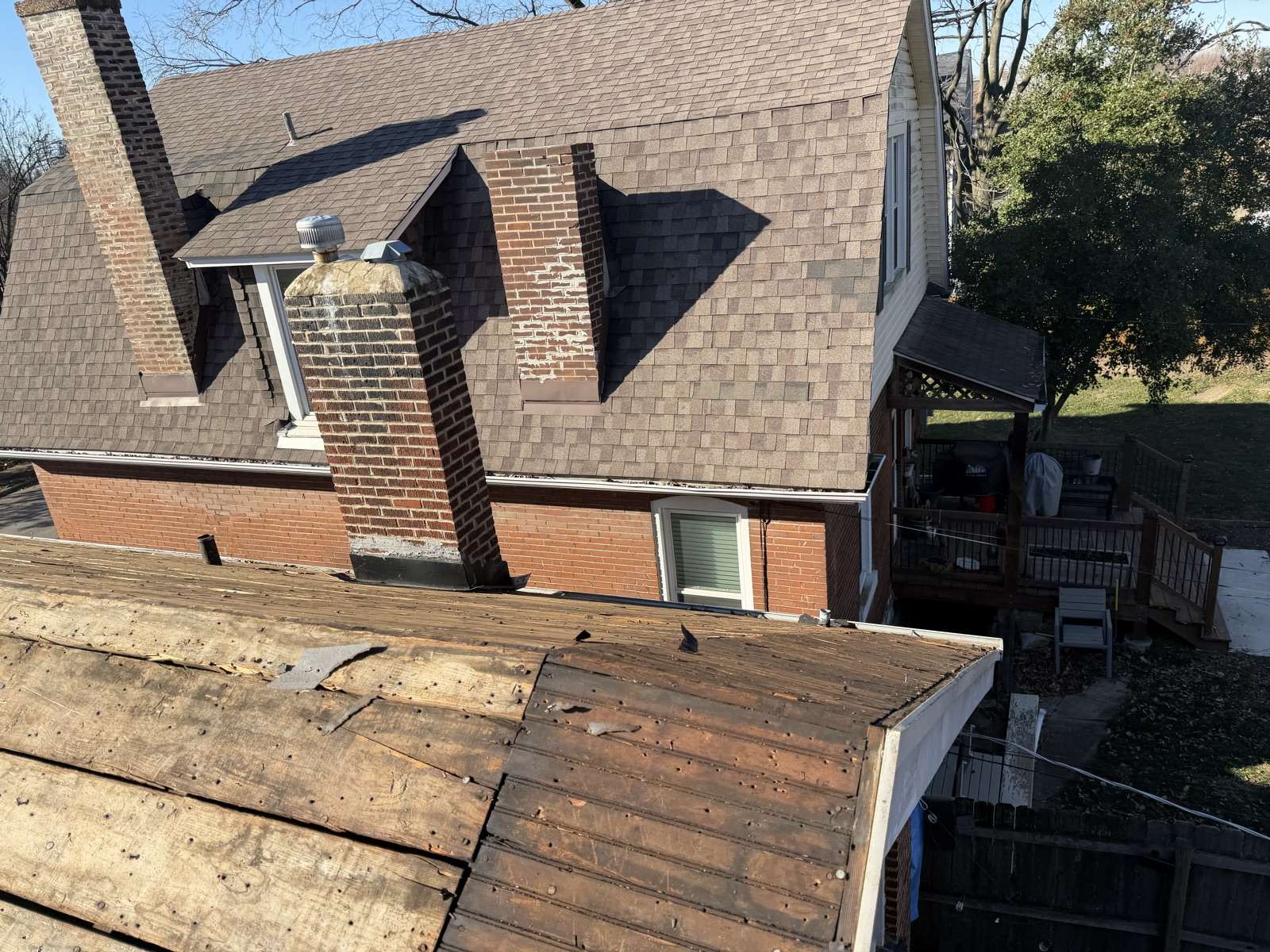
At the top of the size range hail stops bruising and starts breaking. Stones from roughly an inch and a half upward can split a shingle outright, tear the tab, break the sealant strip that holds each course down against wind, or punch through an older brittle shingle entirely. NOAA logged stones up to two and a half inches in St. Louis County across 2020 to 2025, which is tennis ball size and firmly in this territory.
Broken sealant strips deserve their own mention because they are almost never noticed. Once the strip is broken the tab above it is loose, and the next serious wind lifts it. A roof can therefore fail from the wind event in August because of the hail event in April, and the wind gets the blame.
What it is not, which matters just as much
- Blistering. Small raised bubbles that pop and leave a crater, caused by moisture or volatiles in the asphalt, not by impact. Craters from blisters have raised rims and a sharper edge. They are a manufacturing or ventilation issue.
- Foot traffic. Scuffing and granule displacement in a walkable line, usually running toward a chimney or a satellite mount. Directional, not random.
- Mechanical marks. Tool drops, ladder scrapes, and the tell-tale row of dimples where somebody set a boot on a ridge.
- Normal aging. Uniform, everywhere, worst on the south and west faces, accompanied by curling at the tab edges and a chalky look.
A competent inspection is at least as much about ruling these out as about finding hail, because an adjuster who has seen a thousand roofs will rule them out immediately and a report that confuses them is a report that gets discounted.
The one that gets argued about: cosmetic
On metal roofing, metal accessories, and to a lesser extent on some shingle claims, the argument is not whether the hail hit but whether the result is functional or cosmetic. A dent in a standing seam panel almost never affects the panel's ability to shed water. Many policies now carry a cosmetic damage exclusion or a separate cosmetic endorsement that explicitly says so. If you have metal anywhere on the house, that clause is the one to read on your declarations page, before you do anything else.
The practical consequence
Two of the three things hail does are invisible from the ground and one of them has no symptom for years. That is the entire argument for having a roof looked at after a storm rather than waiting for a leak. By the time there is a leak the causal storm is four years back and the conversation about what caused it has become impossible for everybody. Have it looked at while the storm still has a date on it.
Found by hand or not at all
A bruise is found with a thumb, standing on the slope
Suspected soft hits get pressed, confirmed by touch, circled in chalk and then photographed so the mark is visible in the frame. That is the part a drone cannot do and a driveway verdict never does. A counted test square on every slope, measurements, then the scope in writing.
Keys Roofing
That is exactly when it is worth checking
This desk is published by Keys Roofing, the roofing, gutter and downspout contractor for greater St. Louis. When you are ready for someone on the roof with a camera, this is the crew that climbs it.
- Licensed and insured, greater St. Louis
- Atlas and Malarkey shingles, installed by the company you call
- Roofing, gutters and downspouts. Nothing else.
- Every photograph on this desk is a real Keys jobsite
Quicker by phone(314) 220-2333
Nothing looks wrong
Send it, get a callback
Send it with the storm date. The office rings back to set a time. Greater St. Louis.